Recording, answered plainly

Common questions about recording.

The questions we are asked most often by sites deciding whether to record phone calls or radio transmissions: what the law expects, what a recorder can capture, and what it takes to keep one running. If yours is not here, ask us.

General information based on our years of supplying recorders to Australian sites, not legal advice. The industry guideline on participant monitoring of voice communications is the usual starting point, and anything that turns on consent or retention is worth checking with your own legal or compliance people.

Why record

The three reasons sites give us, in the order we hear them.

Are we required to record?

If your work relates to public safety, quite possibly. Fire and emergency services, police, and transport hubs such as airports and train stations are the organisations most often obliged to record calls and radio, and the recordings are relied on during an emergency and afterwards when the event is reconstructed.

How WA Police records its emergency lines
Will it actually settle disputes?

If your business buys or sells over the phone, there is a good chance somebody will disagree later about a price or a quantity. Where the conversation was recorded there are fewer of those disputes, and the ones that happen are settled quickly, because there is something to play back.

How CBH settles a disputed grain contract
Can we use recordings for training?

Yes, and it is one of the more useful things to do with them. Staff dealing with customers need to say the right thing at the right time. Replaying real calls shows what was handled well and where someone needs help, which is harder to teach in the abstract.

What can be recorded

Phone systems, radio networks, and the sources people forget about.

Will it work with our phone system, and what if we replace it?

Red Box and Eventide recorders record telephone systems from all the major manufacturers, including Avaya, Aastra, Alcatel, Cisco, Mitel, NEC, Microsoft Teams, Panasonic and Siemens. If you move to a different supported system later you keep the same recorder. Expect some configuration work, and possibly a licence update.

We want to record a phone system and a radio network. Do we need two recorders?

No. A single recorder can record several telephone and radio systems at the same time. As long as the audio from each can be delivered to one location, it can all be captured together.

Besides phones and radio, what else can be recorded?

Microphones in a control room or meeting room, for ambient recording of everything discussed. Public address announcements, where the PA runs across a VoIP network. And computer screens, recorded in sync with the voice, so you can see what an operator was looking at while they were on the call.

Keeping recordings

Security, retention, and what happens if a recorder fails.

How secure will our recordings be?

Red Box uses a frame-based recording method that splits each recording into fragments spread across multiple files, so the only way to reach a recording is for an authorised user to log in to the recorder. Eventide is built on Linux with security updates provided on a regular basis. Recordari also requires an authorised user to log in, and does not need to sit on a network at all.

How many years can we keep recordings?

As many as you like. Recordings can be exported, and most of our solutions offer extended and network archiving so the archive is not limited by what fits on the recorder. Recordings can also be written to Blu-ray discs for offsite storage.

We cannot afford to miss a recording, even in a disaster. What then?

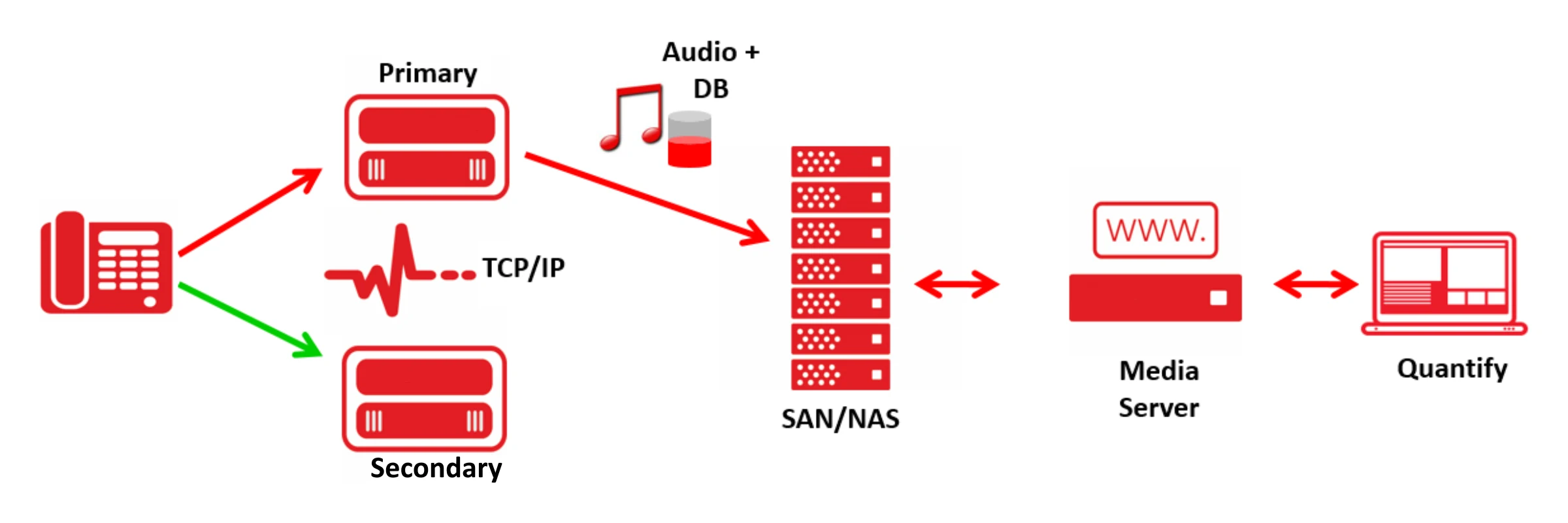
Two recorders running in parallel, either in the same building or with the second at a disaster recovery site. The usual arrangement is a primary recorder that stores and archives everything and a secondary holding a couple of hours, ready to take over if the primary fails, or both recording and archiving constantly so everything exists twice. Remote network storage and Blu-ray archiving add another layer.

Using recordings

Listening in, finding one call, and controlling who can hear what.

Can we hear a conversation while it is happening?

With most of our recording solutions, yes. You can listen live with a short delay, or replay the call the moment it ends.

How hard is it to find one call?

Search by time, extension, agent or line and replay the result in the same window. Most people are retrieving calls confidently after a short handover rather than a training course.

See it working
Can staff be restricted to recordings from their own department?

Certainly. Extensions are assigned to groups and staff access is restricted to their group, so a salesperson hears sales calls and nothing else. It can be narrowed all the way down to a single person hearing only their own telephone.

Can we send a recording to someone outside the business?

Yes. A call and its details export as an audio file you can email or hold for a later review. Exporting recordings is common to settle a dispute with a customer or a supplier.

What it costs

What you pay for, and how little you can get away with.

Is recording expensive?

It does not have to be, and it can pay for itself. A month after we installed a recorder at SA Sea Rescue, operators took a mayday and sent boats and aircraft out. The call was a hoax, and because it was recorded the offender was identified, prosecuted and ordered to pay the search costs, which came to more than the recorder.

The full SA Sea Rescue story
We only need one channel. Is there something simpler?

Yes. Recordari is a standalone VOX recorder that plugs into a handheld radio on a 3.5mm lead and records whenever there is audio, with no server, no licences and no network connection unless you want one. It costs a fraction of a rack-mounted system, and for a single position or a remote site it is usually the right answer.

Recordari

Buying and support

Who puts it in, and who you call when it stops.

Why buy a recorder from CallTech?

We have supplied voice recorders to Australian businesses since 2007, and we only supply solutions that have proven reliable over years rather than the newest thing on offer.

What happens after it is installed?

We do not install a recorder and leave you to work it out. You get training and continued support, and for Red Box and Eventide recorders we make a point of inspecting and updating the system at least twice a year. We also hold spare recorders and parts, so if the hardware fails we can get you recording again quickly.

Can we see it before committing?

Yes. We keep demonstration systems running, so we can show you the interface working with real recordings and walk you through the searching, replaying and exporting your people would be doing day to day. We can also talk through how it would be set up for your channels and your retention rule before anything is quoted.

See the interface
Get in touch

Ask us the one that is not here.

Tell us what you need recorded, where it sits, and how long it has to be kept. We will tell you what is involved, and say so if we are not the right fit.