
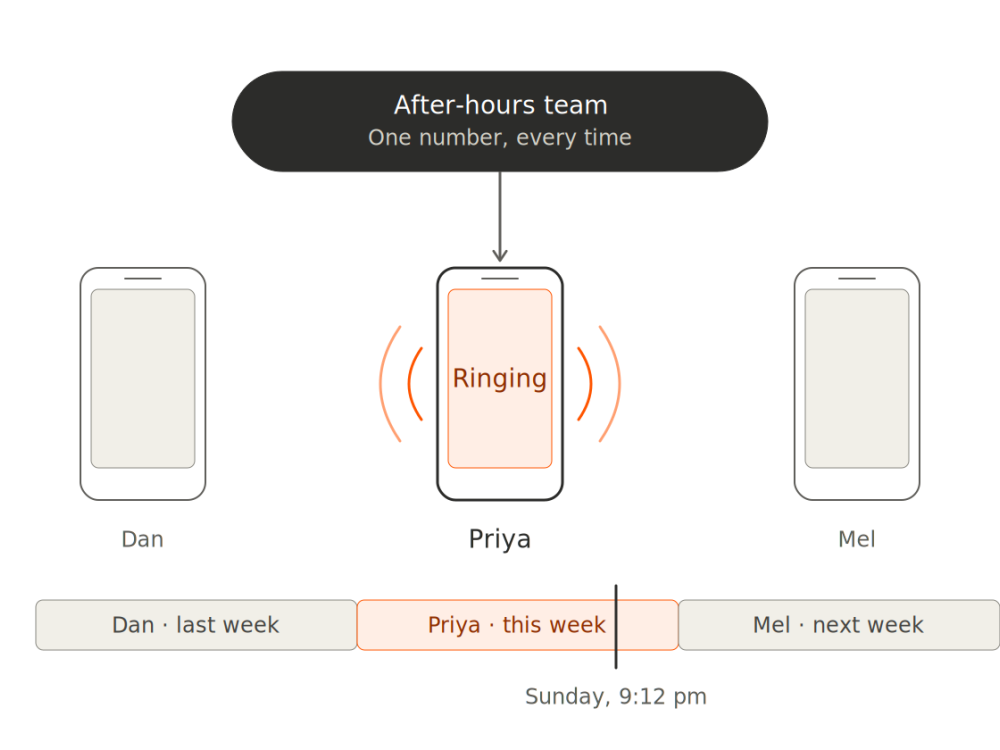
The problem with an after-hours roster is that it has to be looked up, handed over or re-diverted every time it changes. On-Call Router gives each group a number that follows whoever is on call.
On-Call Router is a hosted service that puts each of your on-call groups behind its own number. CallTech provides the numbers and runs the service, so nothing is installed on site. A site with one standby crew needs one number; a utility with a group per region and per department can run dozens.
Taking the roster is a phone call. The person coming on rings the service, enters their group code, and the group's number rings their mobile until someone else takes it on. Callers ring the same number for that group every time. They do not need a roster in front of them, they do not need to be told about a swap, and they cannot ring the person who finished on Friday.
What it replaces
Most after-hours rosters were set up ad hoc over the years, and they tend to take one of three forms. A company mobile that moves from person to person, and has to be charged, carried, looked after and physically handed over. A roster that has to be consulted on every call and kept up to date. Or a divert set on a phone system, and kept in sync with every change.
All three put the work in the wrong place. The first makes taking the roster a logistical exercise for staff, and a phone in someone's car on a Sunday night is not a plan. The second puts the lookup on the person making an urgent call, whether that is your own call centre or a client, at exactly the wrong moment. The third needs an administrator on hand whenever the roster changes, including at 9pm on a Sunday.
Calls do not fall in a hole
Every group has a fallback number sitting behind it. If nobody has registered, the call goes there rather than nowhere, and it is one keypress for the person coming off call to hand back to it.
If the on-call person does not pick up, the caller lands in their mobile voicemail. Every call and every change is logged either way, so an unanswered call is visible afterwards rather than something a caller mentions days later.
Why not just divert a number
A divert fails quietly. One left pointing at last week looks identical to a working one until a call goes unanswered, and nobody finds out until the caller does.
Because the on-call person registers themselves against their own group code, the number is only ever as current as the last person who took it on, and their own group is the only thing they can change.
What your administrators see
Administrators get a browser view across every group: the number each one is pointing at, when it last changed and from which phone, and the calls the service has taken. If someone cannot get to a phone to register, an administrator can set the number for them.